By NC State Extension Master Gardener℠ volunteer Judy Merrifield
The Eastern Box Turtle
(Updated: Feb. 12, 2026, 4:07 a.m.)
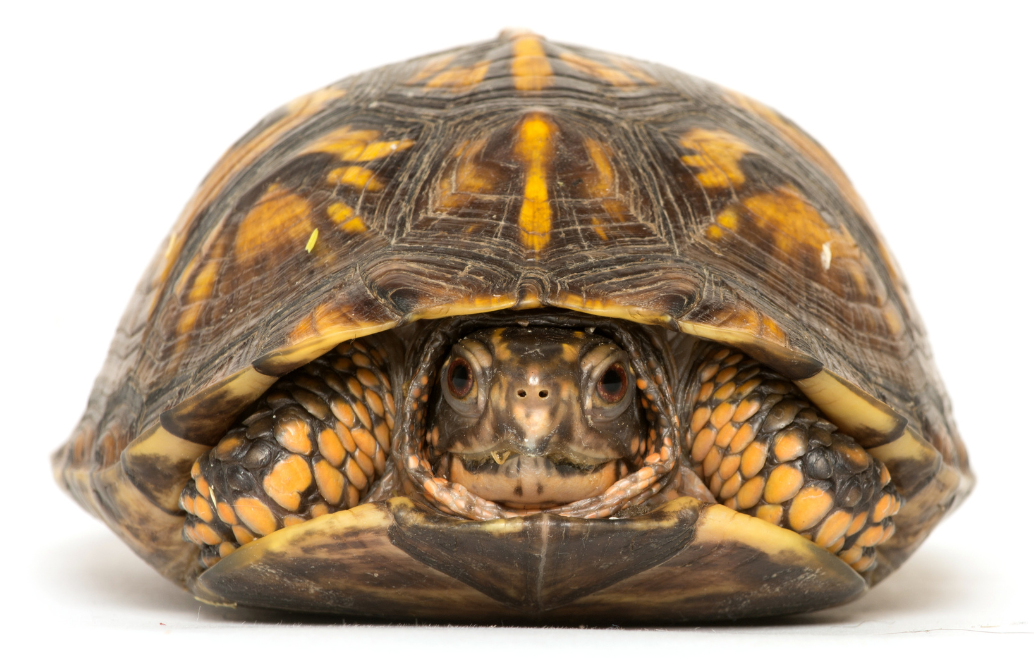
According to the North Carolina Wildlife Resources Commission (ncwildlife.org), the Eastern Box Turtle (Terrapene Carolina Carolina) can be found in fields, forests and neighborhoods all over the state of North Carolina. As many a resident can confirm, we regularly see these turtles here in Transylvania County! In fact, it is the most common terrestrial (land dwelling) turtle found in the eastern United States.
Not only is the Eastern Box Turtle North Carolina’s State Reptile, it is quite a survivor. Their average life span is between 30 to 40 years but can be as long as 100 years. They grow to be between 4 and 6 inches in size. The adults have few predators due to the fact that their lower shell (plastron) can hinge up to the upper shell (carapace) closing like a box. Hibernation for these marvelous creatures is from October through April, so they are hibernating right now and it is unlikely that you will see one until spring.
Males have a slight depression in their lower shell, red or orange eyes, and 4 toes on their hind feet. Females tend to seek out sunny areas in which to lay their eggs. They will return at night to dig a hole and lay between 3 - 8 eggs. At this time, the nest is very vulnerable to raccoons who can get the scent of freshly overturned soil. Eggs are laid in June and July and take 60 - 90 days to hatch. Nests may overwinter if eggs are laid too late in the season. Females do not reproduce until the age of 10 years. Other predators of young turtles in clude skunks, coyotes, ants, crows, and snakes because at this stage the turtle shells are still soft.
The Eastern Box Turtle is an omnivore, eating berries, mushrooms, earthworms, slugs, snails, and a variety of insects. They will bury themselves in leaf matter and come out to eat especially after rainstorms. You’re most likely to see them in the early morning hours.
While it is unlawful to remove a turtle from the wild in North Carolina, if you see one in the road, always carry it to the edge in the direction of which it was headed, and no more than 50 feet. Eastern Box Turtles are excellent navigators and incredibly determined to get where they’re going. Don’t make them cross that road twice because they will.
They are very home-centered and only have a territory of less than 2 acres. NEVER relocate one. They will become very stressed and will try to get back to their area. If you ever find a turtle with a cracked shell, that is bleeding, or has other injuries, reach out to a local licensed reptile rehabilitator. They have a remarkable ability to heal quickly.
If you are interested in attracting our state reptile to your yard there are several things you can do to enhance your chances of attracting young turtles. Create an area of low growing shady spots with leaf litter by planting native ferns, wild ginger, or black cohosh. Planting a few strawberry plants just for them provides a sweet treat! You can also leave all mushrooms in place as they enjoy them as well.
Water is a necessity even for terrestrial turtles. You can provide this by digging a shallow hole, 4 inches deep, and with a 6 x 6 feet area. Line the hole with a rubber lining and then line it with flat rocks. Make sure you clean it frequently with a hose. This makes it more attractive to the turtles and cuts down on mosquito breeding.
If you are lucky enough to find a turtle’s nest in your yard you can cover it with chicken wire but check on it daily and keep the chicken wire on no longer than one week. By then the racoons will lose that scent. Baby turtles need to eat quickly after hatching and can starve to death in a short time.
Join our mailing list!
Enter your email address to receive updates.
Written By